Visitors

Flag Counter
Showing posts with label Blogging special. Show all posts

2 Nov 2013

Top 12 100% Working SEO Strategies

Perhaps the most important and inexpensive strategy is to rank high for your preferred keywords on the main search engines in “organic” or “natural” searches (as opposed to paid ads). Search engines send robot “spiders” to index the content of your webpage, so let’s begin with steps to prepare your webpages for optimal indexing. The idea here is not to trick the search engines, but to leave them abundant clues as to what your webpage is about. This approach is called “search engine optimization,” abbreviated as SEO.

1. Write a Keyword-Rich Page Title. 

Write a descriptive title for each page rich in keywords you want people to find you with using 5 to 8 words. Remove as many “filler” words from the title (such as “the,” “and,” etc.) as possible, while still making it readable. This page title will appear hyperlinked on the search engines when your page is found. Entice searchers to click on the title by making it a bit provocative. Place this at the top of the webpage between the <HEAD></HEAD> tags, in this format: <TITLE>Web Marketing Checklist — 37 Ways to Promote Your Website</TITLE>. (It also shows on the blue bar at the top of your web browser.)
Plan to use some descriptive keywords along with your business name on your home page. If you specialize in silver bullets and that’s what people will be searching for, don’t just use your company name “Acme Ammunition, Inc.,” use “Silver and Platinum Bullets Acme Ammunition, Inc.” The words people are most likely to search on should appear first in the title (called “keyword prominence”). Remember, this title is your identity on the search engines. The more people see that interests them in the blue hyperlinked words on the search engine, the more likely they are to click on the link.

2. Write a Description META Tag. 

Some search engines include this description below your hyperlinked title in the search results. The description should be a sentence or two describing the content of the webpage, using the main keywords and key phrases on this page. Don’t include keywords that don’t appear on the webpage. Place the Description META Tag at the top of the webpage, between the <HEAD></HEAD> tags, in this format:
<META NAME=”DESCRIPTION” CONTENT=”Increase visitor hits, attract traffic through submitting URLs, META tags, news releases, banner ads, and reciprocal links.”>
The maximum number of characters should be about 255; just be aware that only the first 60 or so are visible on Google, though more may be indexed.
When I prepare a webpage, I write the article first, and then develop a keyword-rich title (#1 above). Then I write a description of the content in that article in a sentence or two, using each of the important keywords and key phrases included in the article. This goes into the description META tag.
Next, I strip out the common words, leaving just the meaty keywords and phrases and insert those into the keywords META tag. It’s no longer used much for ranking, but I’m leaving it in anyway. I think it may have some minor value. So to summarize so far, every webpage in your site should have a distinct title and META description tag. If you implement these two points, you’re well on your way to better search engine ranking. But there’s more that will help your ranking.


3. Include Your Keywords in Headers (H1, H2, H3)

Search engines consider keywords that appear in the page headline and sub heads to be important to the page, so make sure your desired keywords and phrases appear in one or two header tags. Don’t expect the search engine to parse your Cascading Style Sheet (CSS) to figure out which are the headlines — it won’t. Instead, use keywords in the H1, H2, and H3 tags to provide clues to the search engine. (Note: Some designers no longer use the H1, H2 tags. That’s a big mistake. Make sure your designer defines these tags in the CSS rather than creating headline tags with other names.)


4. Position Your Keywords in the First Paragraph of Your Body Text

Search engines expect that your first paragraph will contain the important keywords for the document — where most people write an introduction to the content of the page. You don’t want to just artificially stuff keywords here, however. More is not better. Google might expect a keyword density in the entire body text area of maybe 1.5% to 2% for a word that should rank high, so don’t overdo it.


5. Include Descriptive Keywords in the ALT Attribute of Image Tags

This helps your site be more accessible to site-impaired visitors and gives additional clues to the search engines. The ALT attributes do-help get your images ranked higher for image search (see #12 below).


6. Use Keywords in Hyperlinks

Search engines are looking for clues to the focus of your webpage. When they see words hyperlinked in your body text, they consider these potentially important, so hyperlink your important keywords and key phrases. To emphasize it even more, the webpage you are linking to could have a page name with the keyword or key phrase, such as blue-widget.html– another clue for the search engine.


7. Make Your Navigation System Search Engine Friendly

You want search engine robots to find all the pages in your site. JavaScript and Flash navigation menus that appear when you hover are great for humans, but search engines don’t read JavaScript and Flash very well. Therefore, supplement JavaScript and Flash menus with regular HTML links at the bottom of the page, ensuring that a chain of hyperlinks exists that take a search engine spider from your home page to every page in your site. Don’t set up your navigation system using HTML frames (an old, outdated approach); they can cause severe indexing problems.
Some content management systems and e-commerce catalogs produce dynamic, made-on-the-fly webpages, often recognizable by question marks in the URLs followed by long strings of numbers or letters. Overworked search engines sometimes have trouble parsing long URLs and may stop at the question mark, refusing to go farther. If you find the search engines aren’t indexing your interior pages, you might consider URL rewriting, a site map, or commercial solutions.


8. Create a Site Map.  

A site map page with links to all your pages can help search engines (and visitors) find all your pages, particularly if you have a larger site. You can use free tools, XML-Sitemaps.com to create XML sitemaps that are used by the major search engines to index your webpages accurately. Upload your sitemap to your website. Then submit your XML sitemap to Google, Yahoo!, and Bing (formerly MSN), following instructions on their sites. By the way,  Google Webmaster Central  has lots of tools to help you get ranked higher. Be sure to set up a free account and explore what they have to offer.


9. Develop Webpages Focused on Each Your Target Keywords.

 SEO specialists no longer recommend using external doorway or gateway pages, since nearly duplicate webpages might get you penalized. Rather, develop several webpages on your site, each of which is focused on a target keyword or key phrase for which you would like a high ranking. Let’s say you sell teddy bears. Use Google Insights for Search or the free keyword suggestion tool on Wordtracker to find the related keywords people search on. In this case: write a separate webpage featuring the keyword “teddy bear,” “teddy bears,” “vermont teddy bears,” “vermont bears,” “the teddy bears,” teddy bears picnic,” “teddy bears pictures,” etc. You’ll write a completely different article on each topic. You can’t fully optimize all the webpages in your site, but for each of these focused-content webpages, spend lots of time tweaking to improve its ranking, as described in point 10.


10. Fine-tune with Careful Search Engine Optimization

 Now fine-tune your focused-content pages and perhaps your home page, by making a series of minor adjustments to help them rank higher. Software such as WebPosition allows you to check your current ranking and compare your webpages against your top keyword competitors. I use it regularly. WebPosition Page Critic tool provides analysis of a search engine’s preferred statistics for each part of your webpage, with specific recommendations of what minor changes to make. The best set of SEO tools is Bruce Clay’s SEO Tool Set. You can find links to many SEO articles on this site.
Frankly, this kind of SEO fine-tuning is time-consuming, painstaking work that takes a lot of specialized knowledge. For this reason, many small and large businesses outsource search engine optimization. If you’ll explain your needs to me on my online form, I can refer you to appropriate SEO firms that I know and trust.


11. Promote Your Local Business on the Internet

These days many people search for local businesses on the Internet. To make sure they find you, include on every page of your website the street address, zip code, phone number, and the five or 10 other local community place names your business serves. If you can, include place names in the title tag, too. When you seek links to your site (see #15 below), you should request links from local businesses with place names in the communities you serve and complementary businesses in your industry nationwide.
Also create a free listing for your local business on Google Places for Business, Yahoo! Local, and Bing Local Listing Center. That way your business can show up on a map when people do a local search. For more information, see articles on local marketing on my site.


12. Promote Your Video, Images, and Audio Content

Google’s “universal search” displays not only webpage content, but also often displays near the top of the page relevant listings for images, videos, local businesses (see #11 above), and audio clips.  Therefore, consider creating such content appropriate to your business and then optimizing it so it can be ranked high enough to help you. For example, if you were to get a top-ranking, informative video on YouTube that mentions your site, it could drive a lot of traffic to your site. For more information, search on “optimizing images” or “optimizing videos

14 Oct 2013

Most Recomended and popular Websites to Get Free Facebook likes,Twitter Followers, and Youtube Views

Everyone in this world wants to be millionaire over night but these types of things only happen in movies not in real life. Same rule is applied in internet marketing and if you want to earn decent money from internet than you have to be very patient and hard working. Although there is no short cut in internet marketing and blogging but you can increase lets say Free Facebook likes, Free Twitter Followers, Buy YouTube Video Views, Free YouTube Channel Subscribers, Free Google Plus, Free Google Circles and even website views.
The websites are free to join and works based on mutual exchange means if you like other websites fan pages than they will also like your blog fan page. But in between all this website also gets commission and they will put their advertisers fan pages and ask you to like pages. Also you like some one page and do other activity lets says you earn 3 points but when you set your page points you have to set it one point higher like 4 points so that the person who is going to like your page will earn 3 points. One point is obviously go to the websites where you are working so that they also earn commission.
Top 5 Websites to Get Free Facebook likes   Twitter Followers   Youtube Views
Here is a list of Top 5 Websites to Increase Facebook likes, Twitter Followers, YouTube Views, YouTube Channel Subscribers, Google Plus, Google Circles and website views easily and free.

1. Youlikehits.com


I think Youlikehits.com is no doubt the number one fan page like and followers website in the world right now with Alexa rank of 1511 this website got huge traffic. There are many plus points of this website which makes it so popular and that is they follow Twitter’s Rules and Facebook’s Policies. They will never Post Tweets or Status Updates from your Accounts and don’t ask for your account passwords.
Signup process is very simple just provide username, email and password and you will get confirmation code. Enter the confirmation code into the page after you login and click Activate. After you login for the first time you will get 50 bonus points after each passing 24 hours. Not only you can get free Facebook fan page followers here but also you can get YouTube, Digg, StumbleUpon, MySpace and website hits too.

2. Addmefast.com


One of the Top website to get free fans and followers. Currently its Alexa Rank is 6K and increasing which means it has lots of users. The good thing about this website is that there signup process is very simple and you can start earning points immediately after signing up. After signup they will give you 100 bonus points plus if you remain active than every day they will also give you 100 bonus points. You can also earn points by referring this site to your Friends and family members.
The way it works is very simple. All you have to do is to get points either free or by paying money. For free points you have to also like other Facebook fan pages or do some other activity like Auto Website Surfing etc. After you earn some points it time for you to add your website or fan page. Just click on “Add Site/Page” click at the top of the left menu and add your blog link or YouTube channel link what ever you want to promote.

3. Twiends.com


Unlike Addmefast.com this website is only for twitter followers. If you want twitter real followers not bots than this website is a must for you. This website has very authentic way of verifying your twitter account and also your account has to be one month old with 30 followers so that no fake activity can be done here. With 100k members so far and over 300,000+ visitors a month this website is a must for those who want Twitter followers fast and free.
The signup process is very simple. You need a Twitter account in order to verify your account and if your account meet the minimum requirements of Twiends than your account will be instantly approved and you are ready to go. Again you have to earn some points by following other members and you can also earn points by tweeting tweets. Some members may give you higher points based on setting and some may give you low points.

4. Getlikeseasy.com


This website is dedicated to the Facebook only. You can get quality and reliable Fan Page followers here. This website got huge popularity in recent times and prove to be the high quality provider. The thing i like about this website is its simplicity and way it works. They also have a Twitter and Google Plus websites Getplusoneseasy.com and Exchangefollows.com which are also very good sites.
After signup you need to verify your account via your email. Just click the confirmation link send by thee website and login into your account. They will give 20 bonus points and after that you can also earn points by liking other members Facebook fan pages. The more you like the more you earn points. Just add your Fan page after earning some points and see the magic begin.

5. Swapes.com

Swapes is another great free exchange website where you can get lots of free subscribers, followers and page hits too. The best thing i like is that they give you 1000 bonus points when you create a YouTube videos about them and upload it. Also you can earn points by simply write about them on your blog and earn up to 200 points. Of course you can earn free points by doing other stuff like surfing websites, YouTube video watching and thing like that.

Download free Google SEO starter Guide and cheat sheet eBook for optimizing of web

Whether you are a beginner looking to make a mark on the internet or just wanting to learn some stuff, or a pro who wants serious business online, Google is always there to help you. At the Google Webmaster Central blog, you will find any number of news, tutorials, tips, and best practices involved with web mastering. Google wants to help you out in making your content available to the world, and has released many items related to Search Engine Optimization, Google released an eBook some time ago which contained all the basic SEO tips you could think of in a nutshell. Well now, for starters, Google has released a new one-page quick-start eBook which captures the essence of SEO as it is used today.

Dubbed as a 'first steps cheat sheet' by Google, this eBook is specifically designed for people who have set up a blog or an online presence, but haven't given much thought to search. They might have made some content, but don't know the ABC of getting their website into Google Search.


This book is a very short and concise guide on search engine optimization, with tips on how to create SEO friendly design, This will help search engines like Google itself to better understand the content on your site, and hence will increase its visibility.


Take a look at this amazing one-page SEO eBook here.


How to download this eBook?

Here's the direct download link to this eBook;

Download: Google One Page SEO Guide

If you're more of an advanced user, we something for you too! You can check out the more extensive Google SEO Starter Guide that will detail you through most of the basic SEO aspects.

This eBook is free to use, and you can distribute or print it as you like! Give it a read, and share the knowledge with others too and increase awareness! All the best

How to get .gov and .edu backlinks on website and blog

Most people don't know how beneficial .GOV and .EDU backlinks can be, or whether they're useful at all for a website. It is easy to confuse their importance with that of other TLDs (Top Level Domains) such as .COM, .NET etc, and you'd figure that since .COMs are the most popular and the most expensive, ergo they're the most important. We'll, you'd be wrong to think that. A website's trust rating is far more important that what it cost to set it up. And as you can imagine, .GOV and .EDU top level domains enjoy a special level of trust which is regarded very highly by search providers such as Google, Bing and Yahoo. And backlinks from such domains can take your website's rank to another level. Here are some best techniques to get .GOV and .EDU backlinks for your site.

1. Comments

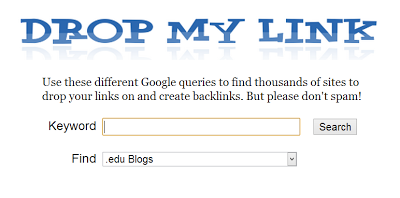
One of the many ways you can build backlinks is by commenting on other blogs. There's nothing quite like it when you get the conversation going. To start off creating a .gov and .edu backlink profile or your blog, start finding such blogs to comment on. A great website that'll help you do that is Drop My Link. You can search for blogs based on the desired keyword. But more importantly, you can select the type of blogs you want to see from the drop-down list. From there, you can choose .edu or .gov blogs, and get the relevant blogs based on your keyword!

Drop My Link

You can then filter out your results. Go for blogs with a high PR first, because commenting takes time, and you don't want to waste time on low ranking blogs.

2. Recognize .edu bloggers

Aside from comments, getting a proper dofollow backlink from .edu and .gov blogs can be very difficult. One strategy is to feature some such bloggers in a post of yours, so that they'll link back to you in return out of gratification. For example, you could create a list of 'the best university bloggers', or 'the best students blogs in the U.S' etc. Small recognition awards like these are sure to get attention, and hopefully a backlink.

To find such blogs, here's a Google Search trick. If you search Google for <site:.edu> (without the angled brackets), you will run a search for all domains with a .edu extension. You can also search a specific site using this method <site:yoursite.com>. If you search Google for <inurl:blog> (again, without the brackets), you will land all webpages with the term "blog" in their URL. You can combine the two to run a search for .edu blogs - <site:.edu inurl:blog>. Moreover, you can add individual search terms within quotes to refine your results according to keywords <site:.edu inurl:blog "technology news">. This way, you can feature 'top university technology blogs'

3. Find resource pages

If your website provides useful information on a particular subject, then you may use that to get inside a university's resource page. Resource pages are there for linking out to other sites where students can find useful information regarding a particular subject. So if you are a computer guru and know your way around Linux development for example, you could contact computing institutes' web team to put out a backlink to you.

You can use the same search trick you used earlier to find resource pages. For example, run a search for <site:.edu inurl:resources "technology"> or <site:.edu inurl:links "Linux"> (without brackets), and you'll find out plenty of universities you could contact.

4. Do some volunteer work

I mean not like charity work. But you can help some university web team design or improve a component on their website in return for a backlink. Now this, of course, requires you to have some web development skills, but you can hire a freelancer to do the job for you too.

All you have to do is, find a university or college site, and look through it if it looks poorly made. Not every university has a full time web design team. Often times, they only intend to give out valuable information, without caring much about how their webpages look. For example, I was recently reading about some research proceedings about a new type of lens technology in cameras at a university, and I couldn't help but notice the colorless, bland design. Now the webpage itself had a very high traffic and the university was very reputable. But in all fairness, researchers working behind the new camera technology most probably wouldn't know about web design, which makes it the perfect opportunity for people to contact them, and offer to redo their design in return for a backlink. Such researchers wouldn't even care about the backlink, as long as they're getting a better design.

5. Hire college students

Now I know this one is unconventional, but hey, so long as it works! In some colleges and universities, students have access to .edu domains, where they are allowed sub-domains of their own. You can set someone up to create a student blog for their college, and then link back to your own website.

There are many ways you could hire a student to do your bidding. You can use the
Reddit ForHire section to post your gig. You can also post a classified on Craigslist. Or, you could always go to one of the many freelancing websites available, where you can post a job.

So, did you like these tips, or would like to add something to them? Feel free to jump on into the comments section below.

Optimize your website by using top SEO softwares

Whoever said you need to go to online services each time you want to look over at the Search Engine Optimization of your website? SEO is not a one-time process. Rather, it's an on-going one, which might make going repeatedly online to different sites a drudging work. To make it easier, there are certain desktop SEO software that you can install right to your computer, and they will work in the background when you're not interacting with them, hence making ordinary tasks SEO tasks easier for you. Here are the 10 best desktop SEO software to optimize your website.

Web CEO Professional Suite

Web CEO Professional is a complete Suite for webmasters, SEO professionals, and even search engine marketers. It integrates more than 12 different tools for SEO related tasks into a single workspace, From keyword research to building targetted traffic, and from finding a niche to performing site promotions on search engines, there's a lot you can do with this powerful SEO Suite.

Traffic Travis

Traffic Travis is all about optimizing your site for increasing traffic. It is a comprehensive SEO software that will give you insights into your competitors, and will suggest ways to improve your ranking and come up ahead of the competition. It can be used to remove errors in your site, and to build quality backlinks.

Internet Business Promoter

This is another great SEO Suite for professionals. Like Web CEO Professional, it also offers a lot of tools. But the primary use of iBusiness Promoter is analysis. Whether you want to do some keyword research, or analyze competitions, or simply want to track how well your keywords are doing, then iBusiness Promoter is for you. It will help you get into the first page of search engine results.

AdvancedWeb Ranking

Advanced Web Ranking can be rightly termed as a complete SEO Software. It provides a complete solution for managing all the SEO related tasks. It provides the most accurate and comprehensive keyword research tools, measures and improves search engine traffic as well as revenue, does effective link building and analysis, provides integration with Google Analytics, provides automated reports, updates and backups, and comes with complete data privacy and enhanced security and reliability.

SEO Power Suite

SEO Power Suite provides world-standard SEO software. It helps to improve the search rankings of your website on the search engines by doing proper keyword research and analysis, building quality backlinks, content optimization, and by doing other SEO tasks as well. SEO Power Suite comes in Free, Professional, and Enterprise versions. It provides powerful tools which make SEO tasks easy and effective and result oriented. Its toolkit includes tools such as Rank tracker, SEO Spy Glass, Website Auditor and Link assistant.

SEO Elite

SEO Elite offers a massive collection of traffic generating tools; reveals how a webpage ranks high in search engines, finds high PageRank sites, finds Super Affiliates, monitors reciprocal links on partner sites, backlink search, reveals how many and which pages each major search engine has indexed, regular updates of your search engine rankings, analyzes and compares special search commands on Google, reveals exactly which sites your competitors are advertising on, uncovers penalized sites you may be linking to, finds link exchange partners, and submit articles to article directories.

Microsoft Free SEO Toolkit

You can make your site search engine friendly using Microsoft Free SEO Toolkit. Free SEO Toolkit eases your efforts for search engine optimization (SEO). It can be downloaded for free. Free SEO Toolkit provides detailed analysis of your website and provides helpful suggestions to improve the overall relevance of your website in the search results. It helps you to grow your website traffic and revenue, controls the access and display of website content in search results, and improves the overall user experience as well.

Apex Pacific SEO Suite

SEO Suite is one of the most advanced and powerful SEO Software which comes with more than 25 SEO tools delivering high quality website optimization. It combines Web Ranking Software as well as Dynamic Submission Software and has hosts of other useful features as well. It comes with Web Site optimizer, Link Building Tools, Reporting Tools, does keyword research and analysis and also monitors the rankings for keywords and does lots of other tasks as well.

Screaming Frog

Screaming Frog is a SEO Spider software that lets you crawl a site or a link list quickly, scanning for target keywords and attributes, or checking for errors or inconsistencies. You can do a lot with this handy tool. And we demonstrated some of the ways you can use it in a previous post. Read the following post for more information;

Rank Tracker

Rank Tracker is a cool SEO tool designed to track rankings of your website for multiple keywords in all major search engines

Recomended SEO settings for Blogger

Apply SEO tactics. SEO makes your content visible to the outside world. Therefore, for your content to actually bring in any traffic, you need SEO. We have previously shared various posts on search engine optimization, but today, I'd like to share some SEO settings that every blogger should apply on their blog. These are specific to Blogger, but that doesn't mean you can't apply some of them to other platforms.

Before writing a post

1. Choose your topic carefully

Choosing the post topic is the most important part of creating content. The topic you choose should be compliant with what your users want. It should be unique and original, and should offer something of value to the users. Then, as you're constructing your post, you should ask yourself some questions regarding the topic and content (see Number 20 below).


2. Check out competition


Always check to see what your competitors are doing; what topics they're posting about, what strategies they're using, and most importantly, what's hot on their websites. I'm not saying that you go ahead and copy them. But take a general hint before coming up with your own content ideas.

3. Check out latest trends


Make sure you follow the latest trends and news on various social media networks. Write about what's hot. Writing on the most recent trends not only brings in a lot of readers, it also tells search engines that your website is dynamic, and provides fresh and latest content to its users.

4. Keyword research before post!

So, you've decided to write about something. But you're looking for words to explain? You have to learn how to do some keyword research first. You will need keywords for various different things, such as titles, meta descriptions, tags, and so on. Check out this article on doing keyword research to find out more about it.

5. The difference between a writer and a blogger

A good blogger might be a good writer, but the vice-versa isn't always true. A good writer might know how to write for readers, but a blogger also knows how to write for search engines. To be a good blogger, you need to adopt a technical style of writing, keep a consistent approach, and a lot more. Check out this post on creating great content that applies to readers as well as search engines.

6. Recommended word limit

There's no such thing as an 'ideal word limit' for a blog post. It purely depends on the number of posts you publish, and the post topic. But SEO experts agree on a minimum of 300 words to avoid penalties. We would recommend a range of 500-700 words on average, since that seems to be the magic number when it comes to readers - neither too short so as to miss out on important things, nor too long for it to get boring.
While writing a post

7. The title is the king!

The title is the most important part of a blog post, since it is the one that actually brings in the clicks. Optimizing post titles is a part of being a good blogger. Check out this post to learn all about creating search engine friendly post titles.

8. Optimize Permalink

Always keep permalinks short. Use custom permalinks of around 4-5 words at max, and separate each word a hyphen "-". Make sure you capture your most important keyword in the permalink (your focus keyword).

9. Intro with keywords

Keep all the keywords you can up with at the start in mind, and use them all in your introductory paragraph. It doesn't matter how many keywords you use in the content. But you must use them all at least once in the intro paragraph.

10. Headings and subheadings

Always use a combination of different headings. Usually, blog titles are H1s, so never use H1s. Post titles are usually H2s, so don't use H2s either. Use them only rarely. For the most part, use a combination of H3s and H4s in your post to specify a clear hierarchy in your content.

11. Typography

Typography refers to the styling of your content. It is almost as important as the content itself. Try to use different colored headings; use italic and bold text to emphasise your keywords, Also, once you're done writing your content, select all by pressing Ctrl + A, and then justify its alignment, so that the text looks neat at both ends.

12. Meta descriptions

The Meta description is the second-most important part of your post (after post title), as it is what users will see on a search engine (along with your title). Write a very short description of at most 170-180 characters, and make sure to include all the important keywords in it which you came up with before writing the actual post.
Linking

13. Inter link

Every post on your blog must have an internal link to another relevant post. This is one of the many ways to improve our rank. Try to at create at least two internal links within your intro paragraph, and at least one or two more in the rest of content. For a detailed guide, read the following post.

14. Be careful with Anchor texts

An anchor text is the text you use to link to another page, and it is what users click to get to that other page. Choosing anchor text is a very important part of linking. Never use a single word anchor text. Always use a phrase. Usually, a three-word phrase is the best option. Always use a keyword phrase as anchor text.

Also, keep in mind to never use the same anchor text twice for the same link. It is considered as keyword stuffing, and/or spamming. Whether on your site or another, always vary the anchor text.

15. Nofollow vs dofollow links

A nofollow attribute in a link tells a search crawler not to 'follow' a link. First of all, when linking to external pages, always link to a page that has a better rank than yours. But if you must link to a lower quality page, always us the rel="nofollow" attribute with the link tag. But never do this for reputable sites, like Google, Wikipedia etc, nor for linking to your own pages.
Visuals

16. Use visual content to enhance your posts

Images, videos, infographics, animations; such things spice up your content. If you have a video related to your content, that's great. Otherwise, try to include at least one image in you blog post. And depending upon the topic, you can add many. But make sure you don't add too many, so much so that the textual content gets snuffed out.

17. Naming files and images

Before uploading a video, audio, or image file, always make sure you rename it. Use meaningful keywords, and separate them with dashes. This way, users and search engines can tell what the file is about just by its file path!

18. Optimize images before uploading

Suppose you want to display an image that is 500 pixels wide and 300 pixels high. There's no point in uploading a 1200x720 image. It'll take up space on your server, and rendering time at the user's end. Do everybody a favour, and scale down your images before uploading them.

19. Image Title and Alt text

Always tag images with Titles and Alt text. And always use relevant keywords. We've compiled some posts for you regarding image optimization. Make sure you check them out!
After writing a post

20. Basic questions to ask about your content

So you've created really awesome content. Great! But before it is internet-worthy, you need to ask yourself a few questions about. If the answer to any of the questions below is no, then there's something wrong with the content!
  1. Have I used good grimmer and punctuation and made little spelling mistakes?
  2. Is the content useful?
  3. Does the content make sense?
  4. unique/original?
  5. It is worth sharing and linking?
  6. Is it appropriately detailed?
  7. Does it have visual content, such as images or videos?
  8. Does it have examples, references, unique ideas?
  9. Is it interactive enough with the readers?
  10. Are there enough calls to action to invoke engagement?
  11. Does it ask readers questions about their own experiences?


21. Blog labels

Organize your blog's structure into a series of Labels (or tags and categories if you're using WordPress). Use at least one, and at max three labels for one blog post. And keep the total number of labels between 15 and 20 (for Blogger blogs, but same for categories in WordPress).


22. Synchronize posts with the traffic

Don't publish your blog 
posts as you complete them. Always schedule them for an appropriate time. For example, monitor your traffic stats and see what time do you get the most amount of traffic. You might want to schedule your posts for around that time. But try to be consistent about your timing. Pick a timing that works for you, and stick to it!

23. Posting frequency

There are no restrictions when it comes to posting frequency. But the more, the better. Try to keep up with at least one post a day. You may write as many as you can per day though. There's no limit. You can even write a hundred if you can afford to.
Other settings

24. Create a sitemap

A sitemap is a listing of all the pages on your site. Often times, search crawlers might miss out on a page because you might not have linked to it in any other page. So to tell search engines to index that isolated page, you have to submit a sitemap to them. You could use a plugin for generating a sitemap, or read our post on Blogger Sitemap Generator for more details.

25. Blog load time

The blog load time is the most important when it comes to user-friendliness. The slower a blog loads, the more users tend to leave it before it's done loading. So always try to keep your load time to a minimum. Here are some tips that should help.
26. Site links
  Site links appear on blogs that have PR 2 or above, and they are a collection of some of the links on your blog that appear in Google search results. They make your blog look more professional. Check out our post on how to tell Google what links to display in site links.

27. Social bookmarking widgets

Add social bookmarking widgets on your blog to improve your social rankings. Search engines like it when they find links to your social profiles. Besides, such widgets make it easier for users to share your content.

28. Directory submissions

Submitting your blog to directories such as DMoz increases the number of backlinks you have, and in turn, your website's rank.

29. Working on your PageRank

PageRank is Google's way of ranking websites. The higher your PR, the better chances you have of getting into search results, and the faster your index rate will be. Read the following post to learn a lot more about PageRank, and how to improve it.

30. Avoiding SEO penalties

In the end, avoid using shady SEO tactics to jump your rank. Always use Search engine friendly techniques to avoid algorithmic penalties. Check out the following posts for more info.Got any questions? Or maybe, have something to add? Please leave a comment below and tell us what you're thinking.

The SEO benefits of using Tumblr for content marketing

Tumblr is one of the many social networks out there. But it's not just another social media network. Many people underestimate the usefulness of Tumblr, even though it has huge potential for SEO and social media marketing. Tumblr is quickly growing in popularity. But still many people are unaware of its benefits. So, in this post let's talk a bit about Tumblr, how it works and how to get started using Tumblr for online marketing. And most importantly, what are the SEO benefits of using Tumblr?

What is Tumblr?

Tumblr is a blogging and social networking platform that hosts more than 131 million blogs and is among the top 15 websites in the United States. Tumblr was founded by David Karp and currently owned by Yahoo. Tumblr lets you effortlessly share anything. Post text, photos, quotes, links, music, and videos from your browser, phone, desktop, email or wherever you happen to be. You can customize everything, from colors to your theme's HTML.

Share on Tumblr effortlessly!
  • Social Networking and Blogging combined
    Tumblr includes both blogging (and microblogging) and social networking features. Tumblr has all the blogging functionality of a blog platform such as WordPress, blogger, etc. Tumblr also include all the social networking features of a social network site such as Facebook or Twitter. This makes Tumblr a unique platform.

Why Tumblr is a big deal?

  • More than 131 million blogs as of 20th September.
  • Tumblr is among the top 15 websites in U.S.
  • More 50% of Tumblr users are under the age of 25.
  • Many people are switching to Tumblr (most of them are teens).
  • Tumblr has unique 300 million monthly visitors.
By 2011 Tumblr had three times more blogs than WordPress. Today Tumblr is the largest hosted blog platform on the web having 300 million blogs. And a large number of world’s largest, leading brands have presence on Tumblr.

Tumblr also has a huge potential for SEO and social media marketing .With user numbers and popularity on the rise, it’s a perfect marketing tool for businesses.

Tumblr – The Benefits?

1) Customization
You are aware that impressions do matter. Tumblr allows you to customize your page. Choose your layout style and find a design that matches your page’s theme. A variety of themes are available. Choose the one that fits your business.

2) Dofollow links

Most blog software creates allows you to create a link to yourself when you comment on a blog post. Links bring traffic to your site when they click the link, but each link can also count as a “vote” for your site with search engines. These backlinks increase your page rank and help your site rank closer to first in search engine results. Dofollow blogs create normal links that count as a vote for your site.

Tumblr offers you a Dofollow backlink for each link you share, which is the biggest advantage. Unlike Facebook or other social media, sharing on Tumblr can actually do you good outside of that social media, and aside from bringing you traffic, it will also help you increase your PageRank.

3) Tumblr tags

Tumblr features a unique tagging system. If you want to add a tag, simply start typing a word and Tumblr will suggest you the relevant tags. Unlike Facebook, Tumblr tags are already used for content discovery. Thus by using relevant tags, there is a good chance of your content to be discovered.

4) Microsites

You can use Tumblr to quickly set up simple, easy to manage and free microsites (Now called as Simple Sites). You can even use your own domain name with these microsites.

Microsites can also be used for redirection to your main website. By building a sleek microsite with quality content would increase your page rank within months.

5) Branding

Tumblr is an excellent platform for promoting your brands. With Tumblr becoming more and more popular, it’s a perfect marketing tool for businesses that are trying to extend their reach. With more than 300 million unique users, you can easily promote your brand. By posting quality content, you will have a strong online presence on Tumblr. You might have heard that “the best marketing strategy online is to Be Everywhere

Make upto 25$ per Gig by using top 10 Alternative of Fiverr


Fiverr originally started out as a new and very unique concept. There were only the big freelancing websites like Elance and Freelancer etc back then. So Fiverr brought a very refreshing change. Whether you are a proper freelancer or just a regular office-going guy, Fiverr gives you a chance to earn some quick bucks so you can cover up your extravagances. Fiverr is also a great place to get your freelancing career started. But the trouble is, Fiverr only allows you to earn $5 minus their commission per gig. For some people, this might not be enough. Luckily for them, many alternative websites to fiverr have emerged over the years. Fiverr was such a success that many others adopted the idea and came up with their own version of Fiverr. Most of these aren't very good, but some might just be better than Fiverr! So here, we will discuss about the top 10 alternatives to fiverr you must try.

Why not Fiverr?

There're a few legit reasons why you would not want to stay with Fiverr. It might seem very attractive, but it does has short-comings. Firstly, it doesn't pay you very well. Now I know people make hundreds of dollars off it every month, but considering the effort, is it really worth it? %5 is sort of a bottleneck which you might want to eventually break out of.

Secondly, you don't even earn a full $5. Fiverr commission is 20%, which is huge by any standards! So essentially, you only get $4, and the remaining one dollar goes to Fiverr. Imagine you complete 200 gigs in a month. You will only get $800, where you could be getting a full grand. That's just $200 down the drain!

Fiverr is no longer what it once was. It started off as a fun place where people could make use of their creativity. But over the years, it has become quite competitive. Much more complicated jobs are being done now for a much smaller price. Let me give you an example. I spotted two different gigs on fiverr. One promised to "Suggest a professional name and motto for a website," while another said, "I will create an attractive dynamic website using HTML, CSS, PHP, and JavaScript for $5."

Do you see the injustice? The guy who suggests professional names probably is a natural at this. He might hardly take 10 minutes to come up with a good name and slogan. But the web-designer has to work for hours, just for a petty $4. Both these guys will earn the same. The point is, Fiverr might just not be worth it if it takes more than 30 minutes t complete a gig. In that case, you need to look on to alternatives, some of which we have right here for you.
Top 10 Alternatives to Fiverr

1. GigBucks

GigBucks is is a very popular alternative to Fiverr. It hosts gigs for all the categories found on fiverr. It gives freelancers the opportunity to charge an appropriate amount of money for their services. A gig can be anywhere in the range of $5 to $50, definitely a big step up from the $4 on fiverr. Just like Fiverr, joining is absolutely free. And you can post as many gigs as you like. A must try for existing fiverr users or other people.
GigBucks

2. Zeerk

Zeerk is another big fish up for grabs. Working at Zeerk can be much more worth your while. You can charge as much as $100 per gig! Now, services can charged appropriately and no one needs feel left out! For small jobs such as $2 or $5 jobs, there is no commission! And I thought Fiverr was cool!
Zeerk

3. SEOClerks

This is one of  my favorite websites. It contains gigs relating to SEO, internet marketing, and other such web services. The great thing about it is, it offers the widest range of money you can ask for your gigs. You could either ask for $1 for a petty job, or you could ask as much as $999 for a high value project. Web masters would love this website. Just visit it and see what i'm talking about.
SEOClerks

4. TenBux

TenBux is very similar to Fiverr. A lot similar, in fact. It has a similar interface, which is simple and easy to use.  It has almost all of the categories Fiverr has. Only big difference is, it allows $10 per gig, twice of what fiverr would allow. Out of the $10, you get $8, which is the exact commission rate as it is with fiverr.
TenBux

5. FittyTown

FittyTown is another website that offers a large amount of money for almost the same things hosted on fiverr for far less. It allows gigs of only $50, nothing more, nothing less. After deduction, you will get $40, a 20% commission deduction. But overall, it's a good website that you must try. Who knows you might get lucky.
FittyTown

6. Dollar3

This website is a lot better than fiverr or some of its alternatives. For one, it pays out through both PayPal and AlertPay. Here, you can host any type of gig for $5, and some other multiples of 3; $3, $6, $9, $12, $15, $27, $45, and $90. Not bad eh? Sign up now and show the world what you've got!
Dollar3

7. TwentyVille

Here's another good alternative. If offers much more than fiverr does. You can host gigs for either $10 or $20. The commission remains the same @ 20%. So you will get $8 or $16. Still, you're better off with this than you are with fiverr.
TwentyVille

8. Tenrr

This is another copy, if not a clone of fiverr. The name, you can see. But the interface is a little similar too. The good thing is, it has a lower commission rate than fiverr. And it allows you to post gigs ranging from $1 to $10. So that's pretty useful as far as categorization of work is concerned. But the problem here is, giggers have to post gigs with lower and lower rates to attract clients. And I must say, $1 is too low for any kind or work, unless it involves suggesting a name or slogan or something.

tenrr

9. GigMe5

Website similar to Fiverr. The interface works very similar. And the services are the same too. $5 gigs, 20% commission etc.

GigMe5

10. Fourerr

Another website very similar to fiverr. Only, it hosts $4 gigs. The rest is the same. 20% commission, payment through PayPal, similar interface, etc. Not better than fiverr, but definitely worth a shot.
Fourerr
That was a list of our top 10 alternatives to Fiverr. If you have more, then do share them with us. Hope this post helped. Go on and try these websites out! Good luck.

Make money online with buy/sell photos on Depositphotos

Are you a blogger or designer who is constantly in search of high quality images and vector graphics to work with? Or are you an enthusiastic photographer and/or designer capable of creating high quality images and graphics or a Blogger who loves promoting affiliate products? In either case, Depositphotos.com is the place you want to be, because it's your one-stop-shop for stock photography, high quality vector graphics, and even videos. You no longer need to pay steep rates for buying photos, as you can obtain royalty-free images from Depositphotos at very inexpensive rates. And if you're a photographer, you can make money while sitting at home by selling your high-quality images!


What is Depositphotos?

Depositphotos is a U.S based microstock agency that has met with remarkable success over the past few years. It was founded in November 2009, and in a span of just over 3 years, more than 13.6 Million files have been uploaded to this site. It now serves customers in over 192 countries and over 15 languages.
So why Depositphotos, you ask? It is a creative content marketplace for your graphics, but there's a lot more to it than just that. Here are some of the reasons why bloggers and web designers should take a closer look at Depositphotos.
Smart search - You can browse images by categories, or search for them using advanced search filters with a lot of variety and sort options etc. You can search by category, contributor, keyword(s), file type, file size and orientation, and so on.
Depositphotos API - An API for developers that allows integration.
A plethora of files to choose from - From Abstract and Vintage/Retro, to Travel, Cities, Sports and Technology, there's a host of over 37 categories you can browse images from. And there are millions of files available, with new files being added daily. So you'll never run out of images and videos to choose from!
Pay-by-SMS - A great and flexible option for buyers in certain countries, who can pay via SMS. All they need to do is send an SMS, and the purchase cost will be deducted from their mobile phone credit.
Free trial-subscriptions
Inexpensive rates, free trial subscriptions, and attractive contributor incentives (see below).
Opportunities for Bloggers!
 
Now here are some special opportunities for bloggers to outshine others! If you're a blogger, you have the chance of obtaining a free subscription from Depositphotos for your personal use, or for holding a give-away for your readers. All you have to do is, write a well-written review for Depositphotos on your blog/site, and then follow the instructions given in the link above. If you pass their requirements, you will get a free subscription which will entitle you to download high-quality images for free!


Affiliate Program
 
Contributors and buyers get incentives in the form of an Affiliate program that rewards them for every friend, family member, or co-worker they refer to Depositphotos. They can also win rewards by promoting the company in several ways.
Bloggers who have photograph related websites/blogs can get $10 for putting up Depositphotos banner on their site. $20 if the site has an Alexa ranking of below 50,000.
If a contributor you referred makes a sale, you get $0.03 per sale. The more you refer, the more you earn!
For every purchase made by a buyer you referred, you get up-to 15% commission.

Pricing and payment options

Buyers have two options to buy photos from Depositphotos, i.e. via the "PRO Subscription plans" or the "Pas-As-You-Go Credits".
PRO Subscription Plans - With the PRO Subscription plans option, you can subscribe for 1 month, 3 months, 6 months or an year. You can choose a subscription type as well, i.e. between 5 photos per day (minimum) to 200 photos per day (maximum), and this will let you download the respective number of photos per day. For most bloggers, anywhere between 5-20 photos per day should be sufficient. The longer and the more images you subscribe for, the better value you get. You can get anywhere between $0.46 per image to $0.15 per image this way.

Pay-As-You-Go Credits - Alternatively, you can buy credits, which you can later use to download images. There's no download limit per day for these subscriptions, as long as you don't exhaust all the credits. You can buy a minimum of 50 credits for $50, and the more you buy, the lower the cost per credit.

 
You can also buy stock images without a long-term subscription. The prices range from $0.5 to $9, depending upon the size of the vector image.

Depositphotos has flexible payment options, and you can pay through PayPal, MoneyBookers, or Webmoney. You also have the option of payment via SMS as discussed earlier.

Payout to sellers

That's a good question actually. Sellers can't set the price for their photos, because that's standardized by Depositphotos exclusively. So image prices do not vary from one to another. Rather, they vary depending on size.

As far as as the amount of money paid out to sellers is concerned, that also depends. There are five levels of contributors, and their rank is determined by the number of downloads they get. The rates for different types of subscriptions also vary, as in, purchases via Pay-As-You-Go and purchases via PRO Subscriptions vary in amount (since they vary in the price as well for buyers). The following table sums up contributor levels and their payouts.
 

Purchase method
Level Criteria Subscription Credits
Green > 499 Downloads $0.30 44%
Bronze 500 - 4,999 Downloads $0.31 46%
Silver 5,000 - 24,999 Downloads $0.32 48%
Gold 25,000 - 149,999 Downloads $0.33 50%
Platinum 150,000+ Downloads $0.35 52%
 

Your views?

So what are you still waiting for? This could be your chance to earn big money out of your passion for photography and graphic design!

If you need to ask questions, please feel free to ask them in the comments section below. In the meantime, sign up with Depositphotos now, and start clickin' Especially don't miss it if you are good with Photoshop or any other
image editing software.

Share

Twitter Delicious Facebook Digg Stumbleupon Favorites More